

Cybersecurity Awareness 2026: Importance, Training, and How to Prevent Cyber Threats
Introduction
Cyber threats are continuously increasing and most businesses are increasingly vulnerable to it. Apart from the training program, cybersecurity awareness is an active activity that aims to inform any interested person about possible threats and their prevention strategies. This article covers the importance, goals, and challenges of cybersecurity awareness and its impact on organizational risk management in enhancing the strength of a company.
What is Cybersecurity Awareness?
Cybersecurity awareness is a training program to educate the employees to identify the potential cyber risks. The training provided the knowledge to identify, prevent and respond to cyber threats. It’s about nurturing a culture where everyone within the organization is willing to take responsibility for safeguarding the organization’s assets and data. It’s not just a one time training session, it is something that requires effort or multiple sessions in order to keep the organization secure.
A strong cybersecurity culture ensures that employees:
=> Identify and avoid phishing scams, malware, and ransomware.
=> Use strong passwords and secure authentication methods.
=> Handle sensitive data responsibly.
=> Know what to do in case of a security breach.
Why is Cybersecurity Awareness Important?
Human error is one reason why many organizations suffer a breach even with advanced defense systems. A report by Verizon on 2023 Data Breaches found that social engineering attacks, errors, and poor credentials usage accounted for more than 80% of breaches. This is precisely why cybersecurity awareness is important for an organization’s security posture.
Educating employees to be on the lookout for potential threats significantly reduces the risk of a breach. The workforce is empowered with suspicious and attack recognition skills via awareness training.
In the absence of frequent updates to a cybersecurity awareness program, an organization faces the risks of legal damage, financial loss, reputation damage, and loss of trust.
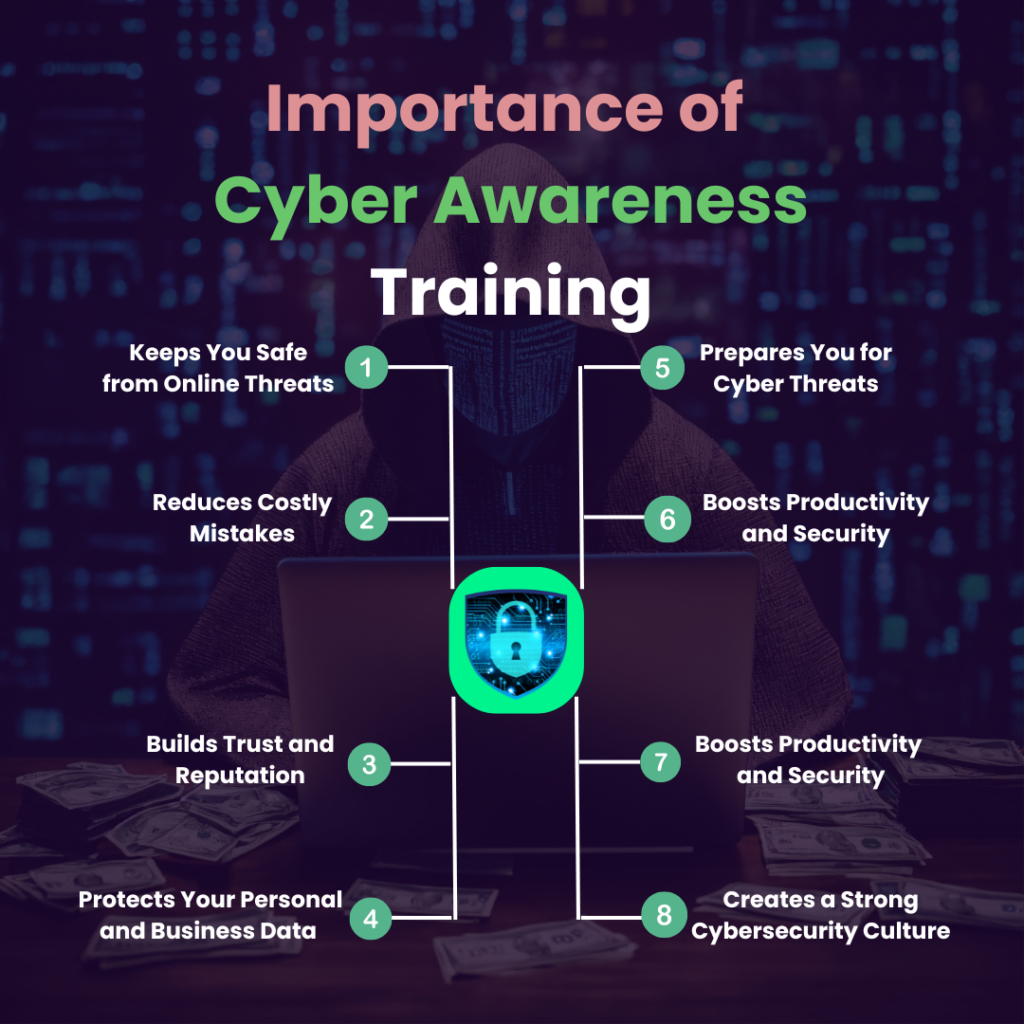
Top Cyber Threats Every Employee Must Know in 2026
If you want to understand cybersecurity awareness, you need to understand what threats there are. Here are the most dangerous cyber threats that target Indian organizations and employees in 2026:
🎣 Phishing Attacks
Fake emails, messages and websites that try to steal your login details or financial information. Phishing emails created by AI will look almost identical to real ones by 2026. Always check the sender before clicking on any thing.
🔒 Ransomware
Malware that encrypts your files and demands payment to restore them. Indian firms saw 53% rise in ransomware attacks in 2025. The best defenses are regular backups and employee awareness.
🤝 Social Engineering
Psychologically manipulating employees into revealing passwords, granting access, or transferring money. These are often in the form of vishing (voice phishing), pretexting or baiting. A well-trained social engineer and a naive employee can get around any technical defense.
💼 Business Email Compromise (BEC)
Attackers impersonate executives or vendors to trick employees into sending fraudulent wire transfers. BEC attacks cost Indian businesses over ₹1,000 crore every year. The most targeted are finance teams.
📱 Mobile Device Attacks
Malicious apps, smishing (SMS phishing) and unsecured Wi-Fi attacks on employee smartphones. Mobile security awareness critical as 75% of Indian employees access work data on personal phones.
🏠 Remote Work Vulnerabilities
Attackers exploit security weaknesses in home networks, personal devices and shadow IT. Remote workers are 3x more likely to be a target . VPN usage, secure passwords and regular training significantly reduce this risk.
Cybersecurity Awareness Statistics in India — 2026
Understanding the scale of the problem in India helps organizations prioritize cybersecurity awareness training:
| Statistic | Data Point |
|---|---|
| India's cybercrime losses (2025) | ₹1.77 lakh crore ($21 billion) |
| Human error contribution to breaches | 82% of all breaches involve human error |
| Average cost of a data breach in India | ₹17.9 crore per incident (2025) |
| Phishing attacks targeting Indian businesses | India ranks #3 globally for phishing targets |
| Cybersecurity awareness training ROI | Reduces breach risk by up to 70% |
| Organizations with formal awareness programs | Only 43% of Indian SMEs have formal training |
The Importance of Cybersecurity Training and its Awareness
Training when combined with cybersecurity awareness is now a critical component to any organization’s cybersecurity strategy for it is easier to mitigate these evolving threats. Simplifying risks and responding to them instantly is a skill achieved by training. These programs are targeted toward breach data prevention by teaching every employee on individual approaches to the multifarious cybersecurity threats that exist and how best to deal with them.
Training should capture the whole spectrum from phishing attempts control to the protection and safeguarding of sensitive data. training must be regularly updated as threat actors constantly evolve their tactics and employees needing to protect company assets.
Objectives of Cybersecurity Awareness Training
The objective of cybersecurity awareness training is to make employees aware about the operations of cybercriminals and the dangers that await them every second. Cyber Security awareness training enables employees to recognize social engineering activities like phishing and business email compromise (BEC) which aim to exploit behavioral tendencies.
Once trained properly, employees are often aware of what to do in particular situations where a potential threat may arise. Cybersecurity awareness training equips them with the necessary knowledge to not only avoid being scammed, but more importantly, report the dubious action. It also strengthens the security posture of the organization by ensuring every member is aware of the importance of safeguarding the organization’s digital assets.
Some Important Elements of Cybersecurity Awareness Training
The efficient cyber security awareness training program includes the safe email practice, phishing, malware, and broader ransomware training for employees. Since email continues to be one of the primary focuses of many cybercriminals, employees must be trained so that they can identify suspicious emails and avoid attachments and links that could be harmful.
Phishing attacks account for over 35% of all data breaches globally. It is essential for employees to analyze the absence of social engineering strategy. Attackers use social engineering to trick employees into revealing sensitive information or granting unauthorized access or provide them with unauthorized access to secure systems.
The reasoning behind prevention and awareness training becomes important to control the ever growing malware and ransomware problem. Overall, employees do not understand these software and how they could, in fact, be so damaging to a network or system. The training policy should cover the issues that employees have in understanding these threats.
Browser security is critical — web browsers are a primary attack surface for cybercriminals. When browsing the internet, employees need to be aware of where their cyber-eye is directed towards as WebBrowsers pose an easy target for cybercriminals to attack.
Data security breaches are common, making proper training on data handling and protection essential. Training should always focus on how as an employee, there is the need to protect sensitive data such as how to store it, handle it, destroy it, and most importantly understanding legal responsibilities around data incident reporting and protection.
Security of Remote Work: Employees should be aware of the risks related to unsecured networks, personal devices, and unsanctioned applications due to the increase in remote work. Through adequate cybersecurity training and training within the remote working environment, these risks can be reduced.
10 Steps to Build a Strong Cybersecurity Awareness Culture
Organizations and individuals can follow these practical steps to improve cybersecurity awareness in 2026:
- Run regular phishing simulation exercises — Monthly test employees with fake phishing emails. Those who fail the test are given on-the-spot training, providing real-world learning without real-world consequences.
- Use strong, unique passwords and a password manager — 80% of hacking-related breaches are caused by stolen or weak passwords. Enforce a 12+ character password policy . Make sure you use a password manager like Bitwarden or LastPass.
- Enable multi-factor authentication (MFA) everywhere — Blocked 99.9% of automated account attacks with MFA. Turn it on for email, banking, cloud storage and all work apps’.
- Keep software and operating systems updated — 60% of breaches are the result of known vulnerabilities with existing patches. Turn on automatic updates for all devices.
- Train employees to recognize social engineering — Train your staff to verify any unusual request for money, access or sensitive information through a different communication method before responding.
- Implement a clear incident reporting procedure — Employees need to know the who, what, when and how of dealing with a breach or a suspicious email. Make reporting easy and blameless.
- Secure remote work environments — Compulsory use of VPN on public Wi-Fi, screen locks, encryption of hard drives, and instructions for working from home securely.
- Run quarterly cybersecurity awareness refresher sessions — Threat landscapes are ever-changing. Quarterly training makes employees aware of new attack techniques and changes to company policy.
- Conduct role-based training for high-risk teams — The most targeted groups are finance, HR and executive assistants. Specialized training in BEC attacks, wire transfer fraud, and data handling.
- Measure and track awareness program effectiveness — Monitor click rates on phishing simulations, incident reports, and quiz scores over time. Measured programs get better. Unmeasured programs stall.
Challenges in Cybersecurity Awareness
Cybersecurity awareness in many organizations is still a challenging task despite the rise of cyber crime activities. One of the major challenges is the availability of training materials. Cyber attacks can happen at any moment and, as a result, training material must always be updated.
Moreover, cyber security awareness programs can also be very challenging due to limited resources. The course content, the equipment used for training, and the course structure must all be thoroughly validated. It can also be difficult to engage employees if the training content is repetitive or overly complex or, on the other end of the spectrum, too difficult.
How to Overcome the Challenges of Raising Cybersecurity Awareness
Corporations can address these issues as follows:
- Updating the training modules with new threats that users face today.
- Making training sessions more fun, interactive, and contemporary.
- Implement phishing simulation exercises and adding them to the standard training procedure.
Want to Build a Career in Cybersecurity?
If cybersecurity awareness sparked your interest in pursuing a career in cybersecurity, CodeTechLab offers industry-recognized courses:
- CEH v13 Ethical Hacking Training in Jaipur — For beginners entering cybersecurity
- OSCP Certification Training in India — For advanced penetration testing careers
- Corporate Cybersecurity Training — For organizations protecting their workforce
- Cybersecurity Internship in Jaipur — For students and freshers
Need Cybersecurity Awareness Training for Your Organization?
CodeTechLab offers Corporate Cyber Security Awareness Training Program for business across India. Our Certified Trainers provide customized sessions for your team either online or at your office in Jaipur.
Frequently Asked Questions — Cybersecurity Awareness
Common questions about cybersecurity awareness answered: